

There comes a point when the garage is full, spare rooms are becoming storage areas, and finding space for everyday belongings starts getting difficult. Perhaps you are moving to a new home in Albury, renovating your property, managing a growing business or simply trying to organise your living space.
Whatever the reason, renting a self-storage unit can be a practical way to manage belongings without having to sell, donate or throw away things you still need.
But if you have never rented a storage unit before, you probably have a few questions. How does it work? What does it cost? Is your furniture safe? Which unit size should you choose?
This guide answers the common questions about self-storage and explains what to consider before choosing a storage facility in Albury–Wodonga.
What Is Self Storage and Why Do People Use It?
Self-storage is a service that allows individuals and businesses to rent a dedicated space for keeping their belongings outside their home or workplace. You choose a unit based on your storage requirements, rent it for an agreed period and use it to store permitted items.
Unlike giving belongings to someone else for safekeeping, self-storage allows you to organise and manage your own unit.
People commonly use storage facilities during:
- House moves and changes in living arrangements
- Home renovations and property improvements
- Downsizing to a smaller property
- Extended holidays or temporary relocations
- Seasonal changes when extra household items need storing
- Business growth when additional space is required
- Decluttering projects that need more than a weekend to complete
For households across Albury, Wodonga, Lavington, Thurgoona and surrounding suburbs, storage can provide extra room without requiring a larger home or commercial premises.
How Does Self Storage Work From Booking to Move-In?
The process is generally straightforward, even if you have never rented a storage unit before.
First, work out what you need to store. Make a list of your belongings and estimate the amount of space required. Next, compare available unit sizes, prices, access arrangements and security features.
Once you select a suitable option, you complete the rental agreement, arrange payment and receive the information needed to access your unit.
At SureSafe Self Storage in Albury, the process includes:
- Make an enquiry: Contact the facility or submit an online quote request with details about your storage requirements.
- Select your unit: Compare the available sizes and storage options.
- Complete your booking: Finalise the agreement and payment arrangements online.
- Prepare your belongings: Pack your items properly and arrange transportation.
- Move into your unit: Use the supplied access information to enter the facility and load your belongings.
SureSafe also provides a complimentary courtesy trailer to help customers with moving their belongings, subject to the facility’s terms and availability.
10 Common Self-Storage Questions Answered
Choosing storage becomes much easier when you understand the practical details. Here are answers to questions people commonly ask before renting a unit.
1. What Is Self Storage?
Self-storage is a rental arrangement where you pay to use a private storage unit for your personal or business belongings.
The unit provides additional space outside your existing property. Depending on the facility, options may include small units for boxes, larger spaces for furniture and equipment, or container storage for bulkier items.
At SureSafe Self Storage, customers can choose from individual storage units and shipping container options in Albury–Wodonga.
2. How Does Self Storage Work?
Self-storage works by allowing you to rent a unit, secure your belongings inside it and access the space according to the facility’s access arrangements.
You generally bring your own belongings, organise them inside the unit and use your designated access details when visiting. Your rental agreement explains the payment terms, access conditions and responsibilities.
At SureSafe, customers can book online, select an available unit and receive the information needed to move in.
3. How Much Does Self Storage Cost?
The cost of self-storage depends on several factors, including:
- The size of the unit you require
- Whether you choose a standard unit or a shipping container
- The type of access available
- Current availability and promotional pricing
- The length of your storage arrangement
For example, a small unit used for cartons and personal belongings will generally cost less than a larger unit intended for furniture or business equipment.
At SureSafe Self Storage Albury, different unit sizes and container options are available at different monthly prices. Check the current pricing page for available spaces, applicable promotions and bond requirements rather than relying on an outdated estimate.
It is also worth checking whether a quoted introductory offer changes after the promotional period.
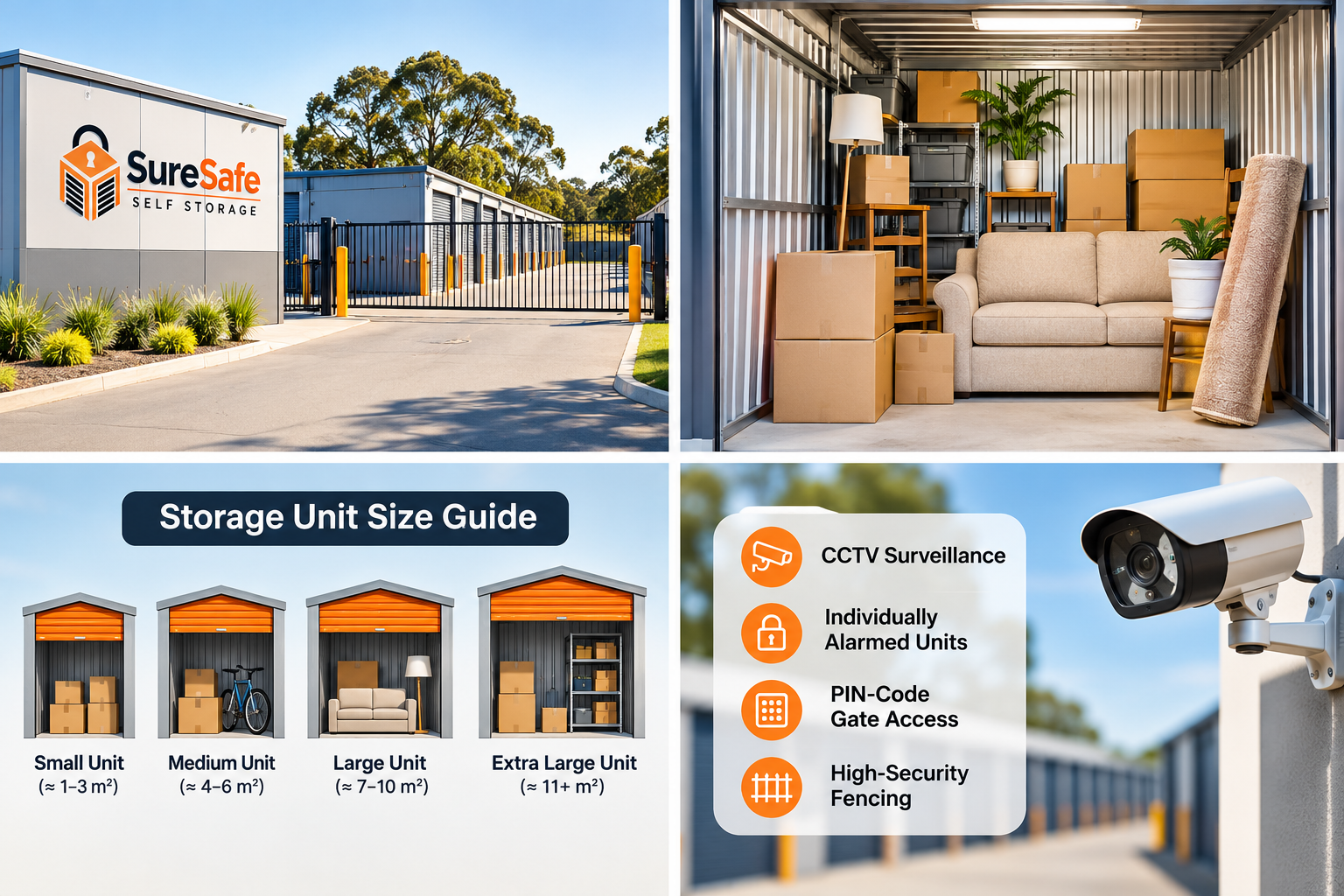
4. What Size Storage Unit Do I Need?
The right unit size depends on the number, dimensions and type of belongings you plan to store.
A simple way to estimate your requirements is to group your belongings before requesting a quote.
| Storage requirement | Suitable storage consideration |
|---|---|
| A few cartons and personal items | Small storage space |
| Seasonal belongings and equipment | Small to medium unit |
| Furniture from a room or apartment | Medium to large unit |
| Household furniture and appliances | Larger storage unit |
| Business stock, tools and equipment | Unit based on volume and access needs |
These are general guidelines rather than fixed size recommendations. Furniture dimensions, stacking requirements and access space can make a significant difference.
Before booking, measure larger items such as beds, sofas, wardrobes and appliances. You can also use the storage space estimator available on the SureSafe website to help identify a suitable option.
5. Can I Store Furniture in a Storage Unit?
Yes. Furniture is one of the most common types of belongings kept in self-storage.
Sofas, dining tables, chairs, mattresses, wardrobes, cabinets and other household furniture can be stored in a suitable unit.
However, preparation matters if you want your furniture to remain in good condition.
Consider these steps before moving furniture into storage:
- Clean furniture thoroughly before packing.
- Make sure all items are completely dry.
- Disassemble large furniture where practical.
- Wrap delicate surfaces to reduce scratches.
- Use suitable covers for sofas and mattresses.
- Keep furniture slightly elevated where appropriate.
- Avoid placing heavy objects on delicate furniture.
- Leave room for ventilation and access.
SureSafe provides clean, dry storage units with marine-grade flooring and ventilation points. Proper preparation and packing remain important for protecting furniture during storage.
6. How Secure Are Storage Units?
Storage security depends on the facility’s design, access arrangements and monitoring systems.
When comparing storage providers, look beyond the appearance of the gates. Ask whether individual units are alarmed, whether access is controlled and whether CCTV surveillance is installed.
SureSafe Self Storage in Albury has several security features, including:
- Individually alarmed storage units
- Secure PIN-code gate access
- CCTV surveillance throughout the facility
- High-security perimeter fencing
- Automatic electric security gates
- Security lighting
- Solid steel storage unit doors
These measures provide multiple layers of protection for customers’ stored belongings. However, no storage facility can guarantee that theft or damage is impossible. Customers should also use suitable locks, follow the rental agreement and check their insurance arrangements.
7. What Can I Store in a Storage Unit?
Storage units can accommodate a wide range of everyday household and business belongings, provided they meet the facility’s storage rules.
Common examples include:
- Household furniture and appliances
- Clothing, bedding and personal belongings
- Books, cartons and archived documents
- Sporting and camping equipment
- Garden tools and non-hazardous equipment
- Business stock and packaged supplies
- Office furniture and equipment
- Seasonal decorations
Some items are not permitted. SureSafe’s published storage guidance excludes explosive, flammable, illegal, perishable and environmentally harmful items.
If you are unsure whether a particular item is allowed, check with the facility before placing it in storage.
8. Do Storage Units Have CCTV?
Not every storage facility offers the same security arrangements, so CCTV coverage is worth checking before renting.
CCTV helps monitor activity around the premises and can support the facility’s wider security arrangements.
At SureSafe Self Storage, CCTV surveillance covers the facility, alongside PIN-controlled gate access, security lighting, high fencing and individually alarmed units.
When comparing facilities in Albury–Wodonga, ask about camera coverage, monitoring arrangements and the other security measures used to protect the site.
9. Can Businesses Use Self Storage?
Absolutely. Self-storage is not limited to households. Small businesses, tradespeople, retailers and online sellers can also benefit from additional storage space.
For example, a local business might need space for:
- Excess inventory and product stock
- Tools and work equipment
- Marketing materials and event supplies
- Office furniture and archived documents
- Packaging materials
- Seasonal business supplies
A separate storage unit can help keep commercial premises organised and reduce the need to rent larger business premises simply to accommodate extra stock.
SureSafe Self Storage offers storage options for personal and business requirements, including standard units and shipping containers.
Before selecting a unit, consider how frequently you need to collect items, the size of your stock and the vehicle access required for loading and unloading.
10. Short Term vs Long Term Storage: Which Is Better?
The right rental period depends on why you need extra space.
Short-term storage is useful when you have a temporary requirement. This might include moving between properties, renovating a home, managing an estate or keeping furniture somewhere safe while waiting for a new property to become available.
Long-term storage is more suitable when you need a place for belongings over an extended period. This could include archived business records, surplus furniture, seasonal equipment or items you want to retain but do not currently have room for.
| Factor | Short-term storage | Long-term storage |
|---|---|---|
| Typical purpose | Moving or renovations | Ongoing extra space |
| Storage duration | Temporary | Extended |
| Main consideration | Convenient move-in and access | Suitable size and ongoing cost |
| Packing approach | Easy to organise and retrieve | Durable packing and labelling |
| Best suited for | Temporary changes | Continued storage requirements |
SureSafe offers both short-term and long-term storage options. Its published rental information also describes month-to-month arrangements, so check the current agreement for minimum periods and notice requirements before booking.
Choosing a Storage Facility in Albury–Wodonga
Once you understand how storage works, the next step is choosing a facility that matches your requirements.
Rather than selecting a unit based on price alone, compare the features that will make a difference during your rental period.
Location: Choose a facility that is convenient for your home or workplace. Consider travel time when you expect to access your belongings regularly.
Security: Look for CCTV, individual alarms, controlled entry and secure fencing.
Storage conditions: Check whether the units are clean, dry and suitable for the items you intend to keep.
Access: Drive-up storage can make loading and unloading furniture, cartons and equipment easier.
Unit options: A facility with different unit sizes and container options gives you more flexibility when choosing a space.
Pricing: Compare the regular rental amount, promotional offers, bond and other applicable charges.
For residents and businesses in Albury, Wodonga, Lavington, Thurgoona and nearby areas, SureSafe Self Storage offers a range of storage options at 99 Bennu Circuit, Albury NSW 2640.
A lack of space does not always mean you need to move to a bigger property or rent additional business premises. Sometimes, a suitable storage unit is all you need to make your existing space more practical.
Whether you are storing furniture during a renovation, keeping business supplies organised or making room for everyday living, choosing the right unit can simplify the process.
SureSafe Self Storage provides individually alarmed units, shipping containers, PIN-code gate access, CCTV surveillance and direct drive-up storage options in Albury–Wodonga.
If you are considering renting a unit, compare the available sizes and request a quote based on your requirements.
Need extra storage space in Albury?
Visit SureSafe Self Storage to check available units, compare pricing or request a storage quote.
SureSafe Self Storage
99 Bennu Circuit, Albury NSW 2640
Phone: 02 6061 0999
Website: https://suresafeselfstorage.com.au/